Gaudí's Criteria: Why His Buildings Are More Than Just Art
"Design is not just how it looks, but how it functions within the soul of the city."
To truly see Barcelona, you must stop looking at Gaudí’s buildings as mere tourist attractions and start seeing them as the result of a rigorous, almost scientific selection process.
By understanding the logic behind his choices, you transition from a casual spectator to a witness of architectural evolution.
* Gaudí viewed architecture as an integrated philosophy of Catalan Modernism rather than a collection of isolated buildings. * His design choices were dictated by structural integrity, organic natural forms, and a deep spiritual narrative. * Mastering his "selection criteria" allows travelers to appreciate the deeper cultural context behind every stone and mosaic.
Why Did Gaudí Choose *This* Over *That*?
The sun hits the stone facade of a building in the Eixample district at 10:15 AM, casting long, jagged shadows that seem to move with the light. Standing on the sidewalk, you realize the curves aren't just for show; they feel intentional, as if the building is breathing.
According to World Bank, Spain recorded unemployment rate of 10.4% in 2025.
Gaudí didn't choose shapes based on fleeting trends. He used natural geometry as his primary blueprint. While his contemporaries were obsessed with straight lines and classical symmetry, Gaudky looked toward the mathematics of nature.
He utilized complex shapes like hyperbolic paraboloids—curves that mimic the strength of trees or the arc of a bone—to ensure structural stability. This wasn't just an artistic whim; it was an engineering necessity.
Whenever I walk through the city, I find myself tracing the lines of a wall with my eyes, trying to find the hidden math. I once spent 45 minutes just staring at a single column in a side street, realizing the curve was actually distributing weight more efficiently than a straight pillar could.
His work was also a vessel for the *Renaixença*, the 19th-century Catalan cultural revival. Every choice of ornament or structural element served to reinforce a sense of local identity. He didn't just build houses; he built monuments to a specific cultural rebirth.
By choosing local materials and traditional craftsmanship, he ensured his work felt rooted in the soil of Catalonia. But how did these massive, heavy structures actually stay standing without collapsing under their own weight?
How were these masterpieces actually selected? Walking into the Sagrada Família at 2:00 PM, the sheer scale of the interior columns makes you feel small, much like standing in a massive stone forest. The light filtering through the stained glass creates a kaleidoscope of color that shifts as the afternoon progresses.
The Sagrada Família represents the ultimate evolution of his selection criteria. The transition from early Gothic-inspired sketches to the current organic, branching column system shows how his engineering problem-solving eventually overtook traditional religious architecture.
He selected forms that could support massive weight while mimicking the way a tree distributes load to its roots. This allows the columns to taper and branch, much like a 100-foot oak tree.
In contrast, Park Güell shows a different side of his decision-making. Originally intended as a luxury housing estate for 60 families, the project shifted into a public park. This transition forced Gaudí to rethink how his vision would interact with a larger community.
The famous *trencadís*—the technique of using broken ceramic shards to create mosaics—was a deliberate choice to bring color and texture to organic shapes while utilizing recycled materials. It was an early form of sustainable design.
Then there are the residential masterpieces like Casa Milà and Casa Batlló. In the Eixample district, where urban density is high, Gaudí had to negotiate light and ventilation.
He selected the undulating facades of Casa Milà to maximize natural airflow and light for the residents, proving that his "art" was always secondary to the human experience of the space. But what happens when the patron's vision clashes with the architect's soul?
| Feature | Sagrada Família | Park Güell | Casa Batlló |
|---|---|---|---|
| Primary Driver | Spiritual/Structural | Community/Nature | Urban/Light |
| Key Technique | Branching Columns | Trencadís Mosaics | Organic Facade |
| Core Philosophy | Verticality & Divinity | Integration with Landscape | Play of Light & Color |
How do I balance the commission with my own vision? A client sits in a dimly lit office in 1900, pointing at a blueprint and demanding more gold, more marble, more traditional grandeur. The architect sits across from them, knowing that the requested changes will compromise the structural integrity of the entire vision.
This tension defined much of Gaudí's career. He often had to negotiate between the specific demands of wealthy patrons and his own uncompromising artistic integrity. While some clients wanted status symbols, Gaudí wanted living organisms.
He frequently pushed back against traditionalist demands, moving toward more radical forms that required new ways of building. This often led to friction with the local authorities and the wealthy elite of Barcelona.
Budget and timeline also played massive roles in his final selections. Not every grand idea could be realized. The "final" form of many buildings was a compromise between the initial concept and the practical limitations of 20th-century technology and funding.
However, even within these constraints, he managed to weave his core philosophy into the finished product. Even when the budget only allowed for 10% of the planned ornamentation, the geometry remained perfect.
Collaboration was another silent factor. While we view him as a lone genius, he worked alongside engineers and craftsmen who helped translate his complex mathematics into reality. The final selection of form was often a dialogue between the architect's vision and the builder's capability.
But what about the work that doesn't make the history books?
Beyond the Big Three: Minor Works and Conceptual Consistency
You turn a corner in a quiet neighborhood like Gràcia at 6:00 PM and find a small, unassuming house. It doesn't have the fame of the Sagrada Família, but the way the window frames curve and the way the ironwork mimics vines tells a familiar story.
Gaudí's smaller residential projects are where his true laboratory lived. These minor commissions allowed him to experiment with the seeds of his larger ideas.
A specific way of shaping a doorframe or a unique way of tiling a patio in a small house often became the refined element used in his massive cathedrals. These were the prototypes for his genius.
His studio drawings and scale models are equally important. These were the "unselected" options—the thousands of ideas that didn't make the cut but provided the groundwork for the successful designs.
By studying these, we see a consistent pattern: a recurring obsession with tree-like structures, undulating lines, and the interplay of light. This consistency proves that his work wasn't a series of random artistic outbursts. It was a singular, cohesive philosophy applied to different scales.
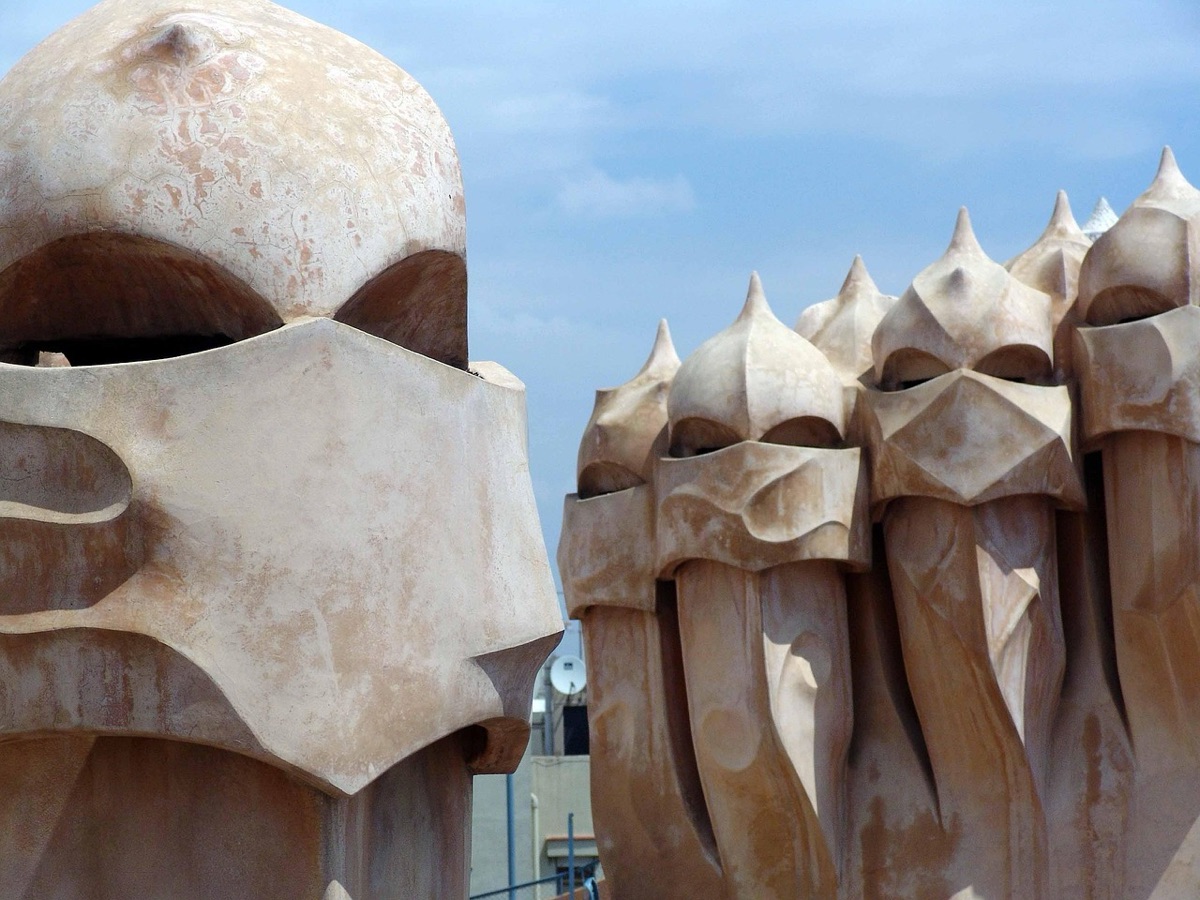
Whether it is a massive basilica or a small chimney, the "selection criteria" remain the same: nature, structure, and soul. But how does this influence the modern visitor?
The Legacy of Selection: Gaudí's Enduring Influence
The shadow of a massive stone tower falls across the plaza at sunset, reminding everyone of the man who changed the skyline forever. The city has grown around his work, but the work has not changed to fit the city; the city has changed to accommodate the work.
Gaudí’s rigorous selection process is why his work has survived the test of time. He wasn't just a decorator adding flair to buildings; he was a revolutionary architect who redefined how structures interact with the environment.
His ability to blend mathematics, nature, and spirituality into a single cohesive language is what makes his work timeless. It is why people still stand in line for 2 hours just to see a single facade.
His legacy is not just in the buildings themselves, but in the way they teach us to look at the world. He reminds us that true design is about finding the perfect balance between the practical and the profound.
As you walk through Barcelona, remember that every curve has a reason, and every stone was chosen with purpose.
How to Experience Gaudí Like an Insider
- Start with the Basics: Spend your first morning at the Sagrada Família to understand the scale of his structural logic.
- Walk the Eixample: Spend an afternoon walking the streets between Passeig de Gràcia and Carrer de Mallorca to see the residential masterpieces.
- Visit the Small Houses: Head to the Gràcia district to find the smaller, experimental works that show his process.
- Analyze the Light: Visit the museums or the interiors during the late afternoon (around 4:00 PM to 6:00 PM) to see how light interacts with the geometry.
- Reflect on the Details: Stop at a local cafe and look at the ironwork or tilework of the building you are sitting in; look for the natural patterns.
#




Comments 0