Gaudí's Genius: Nature as Blueprint for Modern Architecture
"Architecture is the expression of the soul through the language of form and light."
Whenever travelers stand beneath the towering spires of the Sagrada Família or walk through the undulating stone waves of Casa Milà, they aren't just looking at buildings; they are looking at a manifesto.
Understanding why Gaudí chose specific shapes, materials, and scales is the key to moving from a mere tourist to a true witness of his genius.
* Structural Organicism: He selected forms that mimicked the mathematics of nature to solve complex engineering problems. * Catalan Identity: His work was a deliberate tool for the *Renaixença*, asserting a unique cultural voice through stone. * Evolutionary Vision: His selection criteria shifted from decorative revivalism to a profound, structural "living" architecture.
Why Did Gaudí Choose *This* Style?
In the heat of the afternoon, a hand brushes against the rough, sun-warmed stone of a Barcelona balcony as the shadows stretch across the street.
The sun hits the terracotta tiles of an old rooftop in the Eixample district at 10:15 AM, casting long shadows that look remarkably like the curves found in Gaudí’s early sketches. Standing on a balcony in Barcelona, you realize his style wasn't an accident or a whim; it was a calculated rebellion.
According to the World Bank, Spain recorded an unemployment rate of 10.4% in 2025.
Gaudí didn't just wake up one day and decide to build dragon-shaped houses. His early work was rooted in more traditional, academic styles, but he quickly grew restless with the rigidity of straight lines.
He began to see the limitations of classical architecture, which often prioritized human-made symmetry over the organic perfection found in the natural world.
The movement known as *Modernisme Català* provided the philosophical fertile ground for this shift. It wasn't just an aesthetic trend; it was a movement of identity. By moving away from the heavy, classical styles of the past, Gaudí used his work to signal a new, modern Catalonia.
He chose materials like local stone, wrought iron, and ceramic to ground his fantastical visions in the actual earth of the region.
His transition toward organicism was a move toward structural honesty. He realized that nature doesn't use right angles to support weight, so why should he? This rejection of academic revivalism allowed him to experiment with shapes that were both beautiful and functionally superior.
He wasn't just decorating a building; he was trying to find the most efficient way to stand up.
But how did these theoretical shapes actually hold up the weight of a cathedral?
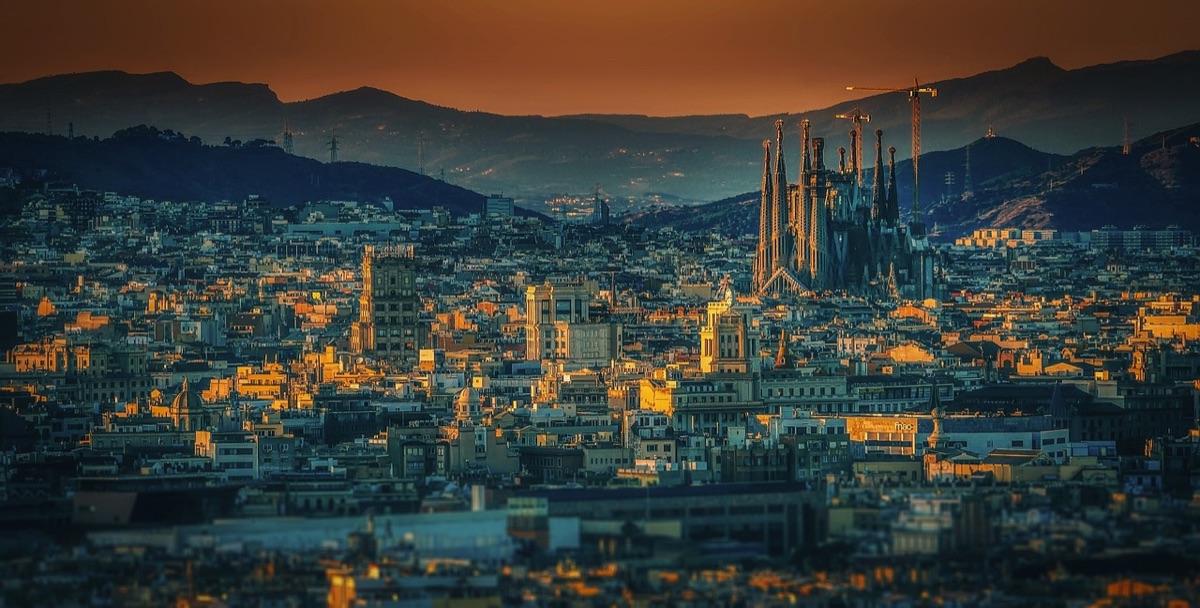
Is the Sagrada Família a pilgrimage in stone? At dusk, the scent of incense fills the cool nave as eyes drift upward toward the towering stone branches.
The air inside the Sagrada Família is heavy with the scent of incense and the warmth of filtered light, moving in slow, colorful waves across the floor. As you look up, the massive columns don't look like pillars; they look like trees reaching for the heavens.
The Sagrada Família represents the absolute apex of his selection criteria. What began as a traditional Gothic-inspired project evolved into a complex, geometric masterpiece that defies standard architectural logic.
The evolution of the basilica reflects Gaudí's journey from a master builder to a visionary who viewed architecture as a divine dialogue.
He solved the problem of massive weight through biomimicry. Instead of using heavy flying buttresses like traditional Gothic cathedrals, he designed columns that branch out like trees.
This allows the weight of the roof to be distributed downward through the "trunks" to the ground, much like how a forest canopy functions. This wasn't just for show; it was a structural necessity to achieve unprecedented height and light.
The integration of light is perhaps his most deliberate choice. He didn't just place windows; he used stained glass to create a theological narrative. The transition from cool blues to warm reds creates a sense of moving through different spiritual realms.
The building functions as a living organism where light, geometry, and faith intersect.
However, the genius of the cathedral is only one piece of the puzzle.
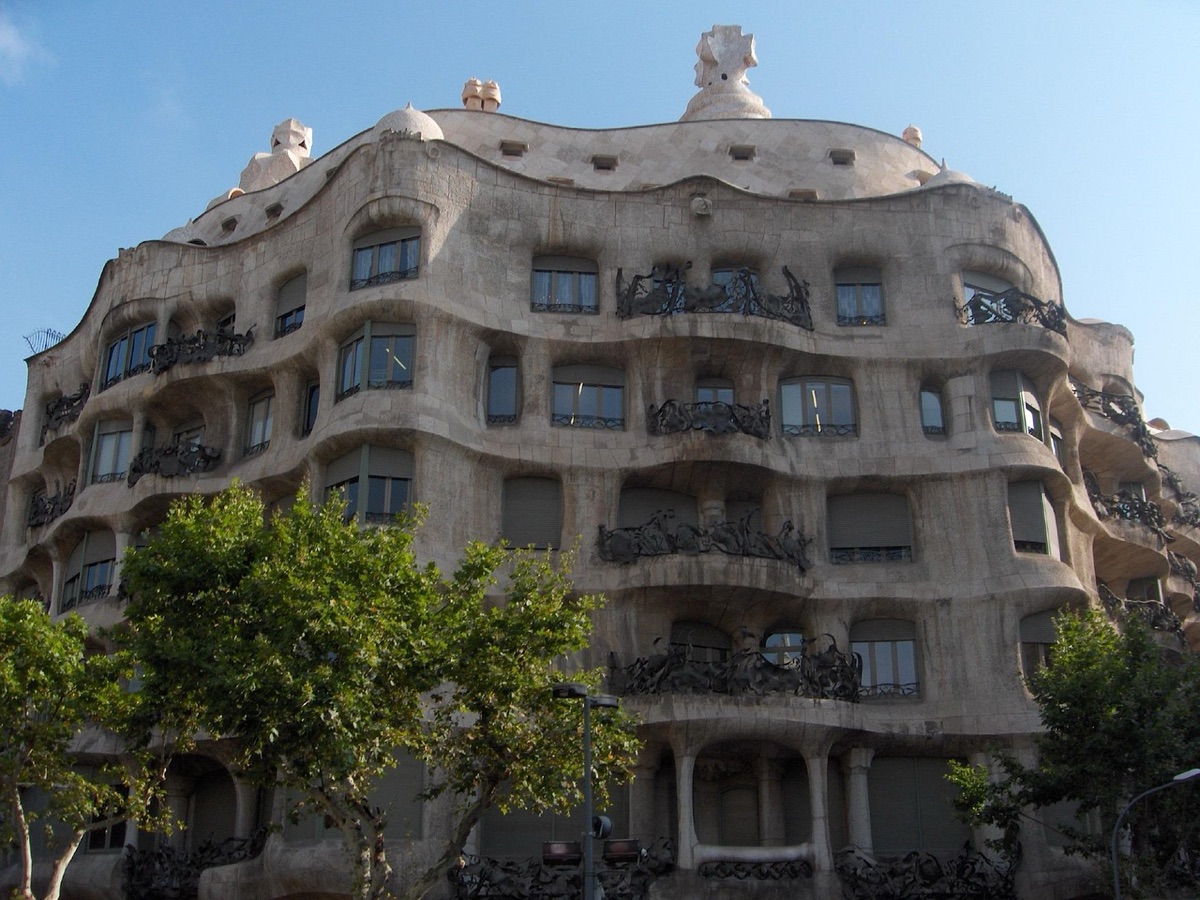
What lies beyond the basilica in its masterpieces? Walking down the Passeig de Gràcia at 4:00 PM, the transition from the organic curves of Casa Batlló to the heavy, stone undulations of Casa Milà feels like moving between two different worlds. Each building tells a different story of how his principles could be applied to human life.
While the Sagrada Família is a vertical ascent toward God, his residential works show how his principles apply to the street level. *Casa Batlló* is a masterclass in fluidity, using skeletal shapes and colorful mosaics to create a sense of movement.
In contrast, *Casa Milà* (La Pedrera) focuses on geometric density and massive stone volumes, proving his ideas could scale to massive apartment blocks.
A key element in his selection was the use of *Trencadís*—the technique of using broken ceramic shards to cover curved surfaces. This wasn't just a way to use leftover materials; it was a brilliant way to wrap complex, organic shapes in vibrant color.
It allowed him to turn jagged, broken pieces into smooth, shimmering skins for his buildings.
His early commissions, like the Palau Güell, served as the laboratory for these ideas. In these spaces, he tested how much "life" he could inject into a domestic setting.
He viewed the building as a living organism, where every door handle, window frame, and balcony was part of a unified, breathing whole.
But what exactly was the source of this "life"?
The Dialogue with Nature: Gaudí as Bioconstructor
A single seashell sits on a museum table, its spiral perfect and mathematically precise. To a casual observer, it is a beautiful object; to Gaudí, it was a blueprint for an entire structural system.
Gaudí was essentially a "bioconstructor." He didn't just copy the look of nature; he studied its mechanics. He used complex shapes like hyperbolic paraboloids—shapes that mimic the curves of certain shells or leaves—to create surfaces that are incredibly strong yet lightweight.
This allowed him to create wide, open spaces without the need for massive, intrusive supports.
His use of biomimicry was rooted in the practical application of structural mechanics. By studying how bones distribute weight or how tree trunks handle wind loads, he developed a way to build that felt natural because it followed the laws of physics.
He moved beyond "imitation" into "structural necessity." If a shape was curved, it was because the mathematics of the load required it.
Even the way light interacts with his surfaces was a calculated structural element. He used light refraction to soften the heavy stone, making massive structures feel weightless.
He understood that light is not just something that enters a building, but something that can be shaped and directed to define the volume of a room.
This mastery of nature leads to a final, profound question of identity.
Cultural Resonance: Gaudí and Catalan Identity
The sound of a bustling Catalan market or the sight of a local festival reminds you that this city has a soul that is fiercely independent. Gaudí’s work is the visual heartbeat of that independence.
His architecture served as a visual manifesto for the *Renaixença*, the 19th-century rebirth of Catalan culture. During a time of political tension and identity shifts, his work provided a sense of permanence and unique pride.
He wasn't building in a "Spanish" style or a "French" style; he was building in a "Catalan" style.
The shift from architecture to a *Gesamtkunstwerk* (a total work of art) is what makes his legacy so heavy. He didn't just design the walls; he designed the furniture, the lighting, the door handles, and the very way a person moves through a room.
This holistic approach ensured that the cultural identity he was building was inescapable.
Today, his works remain central to the identity of Barcelona. They are not just tourist attractions; they of the pillars of the city's cultural landscape.
His ability to blend the technical with the spiritual, and the local with the universal, is why his work continues to be studied and revered globally.
| Feature | Traditional Architecture | Gaudí's Approach |
|---|---|---|
| Primary Shape | Straight lines and right angles | Organic curves and complex geometries |
| Structural Logic | External supports (buttresses) | Internalized, tree-like load distribution |
| Material Use | Standardized, uniform materials | Mixed textures, *Trencadís*, and local stone |
| Relationship to Nature | Nature as a subject to be depicted | Nature as a structural blueprint |
| Design Philosophy | Academic and revivalist | Biomorphic and holistic (*Gesamtkunstwerk*) |
How to Experience Gaudí Like a Local
When I first visited Barcelona in the spring of 2025, I realized that rushing through these sites is the biggest mistake a traveler can make. To truly understand the work, you need a plan that respects the scale of his vision.
- Start with the Basics: Spend your first morning at the Sagrada Família to understand his vertical logic before tackling the residential streets.
- Walk the Eixample: Spend at least 4 hours walking between Casa Batlló and Casa Milà to see how the streetscape changes.
- fully
- Look Up and Down: Always check the door handles and the floor mosaics; the details are where the "living" element is most present.
- Time Your Visit: Visit the Sagrada Família during the late afternoon when the stained glass creates the most dramatic light displays.
- Use the Map: Keep a physical map of the district to navigate the winding streets of the Gothic Quarter and Eixample effectively.
#



Comments 0